


Is It Better to Make Your Wedding Dress Locally or Overseas? A Process Comparison

Planning your wedding gown often begins with excitement and dreams of the perfect dress. Yet, as you explore options, you may find yourself caught between efficiency, budget, and the desire to get every detail just right.
Choosing between a one-trip overseas custom gown experience and a local design journey with multiple fittings can feel difficult at first. Yet the difference often extends beyond convenience alone. It shapes how much space there is for refinement, collaboration, and the gradual development of a gown that feels truly aligned with you.

Two Timelines for Your Wedding Dress
When you consider custom designed wedding gown options, the timeline often falls into two broad categories: the one-trip overseas experience and the local, extended design process in Singapore.
One-Trip Overseas Experience
In this approach, you travel abroad ( often to renowned ateliers in Europe, the US, or regional studios in countries like Vietnam or China) for a single, intensive appointment.
During this visit, you make many decisions quickly: fabric choice, silhouette, embellishments, and measurements. The process is efficient, designed to fit into a short window, sometimes just a few days.
This compressed timeline means you must trust your initial instincts and the expertise of the overseas tailor. The consultation is brief but focused, and the entire gown is crafted based on these early decisions. You might receive your dress before returning home or have it shipped later.
Time-Based Local Design Process
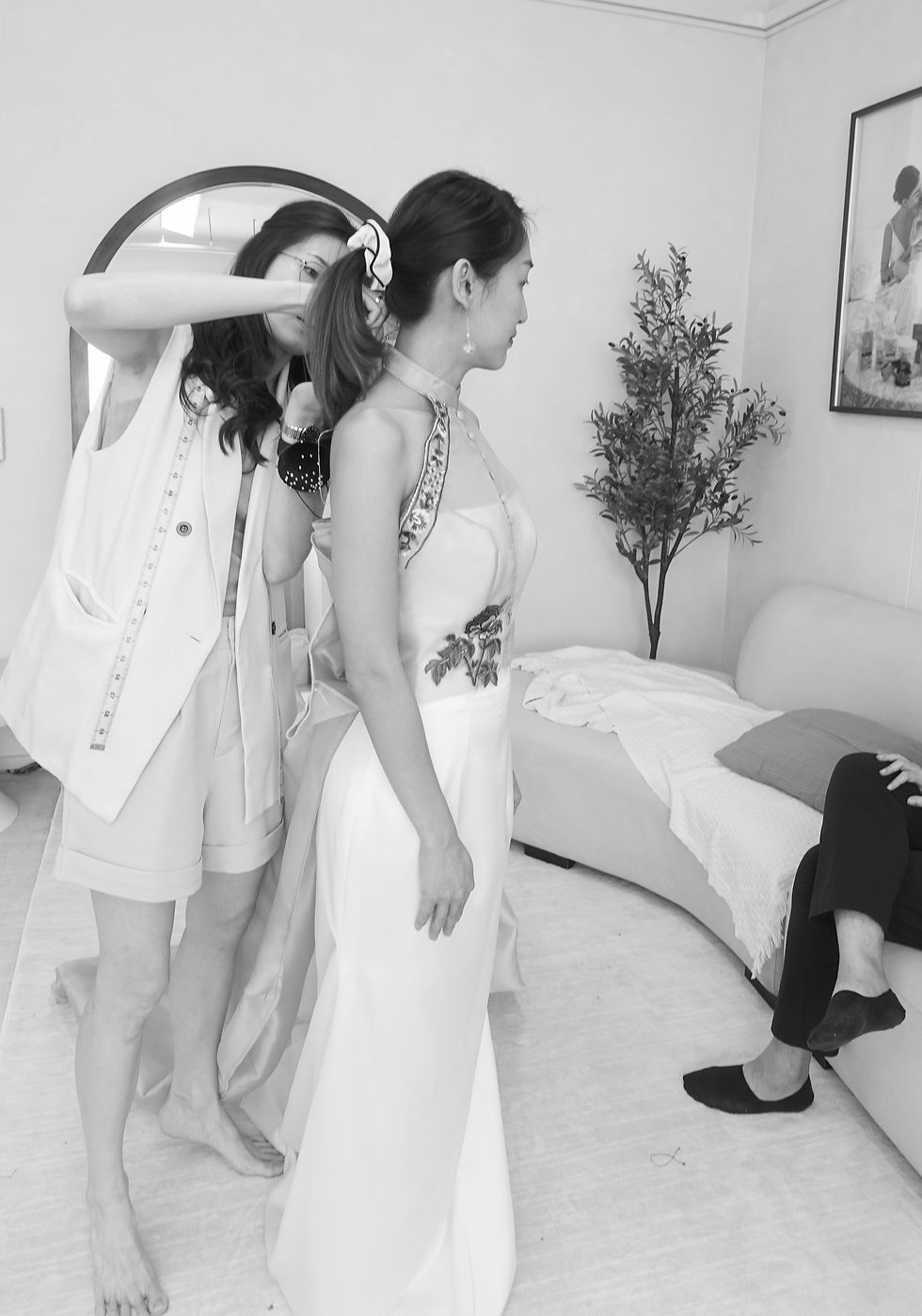
By contrast, working with a local bridal gown designer in Singapore allows the gown to develop gradually over time. The process unfolds across multiple consultations and fittings, creating space for ideas, preferences, and details to evolve naturally. What begins as an initial concept is refined thoughtfully through each stage of the journey.
This slower timeline also allows for a deeper relationship with both the designer and the craftsmanship behind the gown. With each fitting, adjustments are made to refine proportion, comfort, and movement, ensuring the piece continues to align with both your vision and the way your body feels over time. Spanning several months, the bespoke process allows clarity to emerge gradually, resulting in a gown that feels considered in every detail.
What Shapes the Final Dress
The final look and feel of a gown is often shaped as much by the process behind it as the design itself. A one-trip made-to-measure experience relies on clarity and precision from the outset, where many decisions must be resolved early, with limited opportunity for refinement along the way.
By contrast, a local, time-based design process allows the gown to evolve alongside the bride wearing it. Across multiple fittings, there is space to observe not only how the dress looks, but how it feels in movement, proportion, and presence. Preferences that once felt certain may shift subtly when experienced in real life.

Often, the most meaningful refinements emerge through this process. A neckline may feel more balanced raised slightly higher. The volume of a skirt may need softening to better complement the frame. A train may be adjusted to move more naturally through the space of the day. These decisions are rarely fully realised in imagination alone. They come from seeing the gown repeatedly on the body, allowing adjustments to unfold gradually until the final piece feels resolved in both form and feeling.
The Role of Time in Your Bridal Experience
Time allows your vision to mature. Initial ideas often shift as you try on different styles or as your wedding plans take shape. The custom wedding dress process is not just about the dress itself but about how you feel wearing it.
Preferences evolve, and clarity often comes after the first fitting or even the second. This is why many brides appreciate the wedding gown fitting stages offered by local designers. They provide space to explore, adjust, and perfect.
On the other hand, the one-trip overseas approach demands confidence in your choices upfront. It suits brides who prefer a streamlined process or have limited time but may feel rushed in decision-making.
Reframing Your Choice
Instead of asking, “Where should I make my dress?” consider, “What kind of process do I want?” This shift helps you focus on your experience rather than just location.
Do you want a bespoke bridal experience that unfolds over months, with personal attention and evolving design?
Or do you prefer an efficient, focused trip abroad, trusting the tailors to deliver your vision quickly?
Both paths have value. Your choice depends on how you want to engage with your gown’s creation and how much time you want to invest in the journey.

Comparison Table
Stage | Overseas One-Trip Experience | Local Time-Based Process |
Decision Making | Many decisions in one appointment, fast-paced | Gradual decisions over multiple sessions |
Fittings | Usually one or two, limited adjustments | Multiple fittings, ongoing refinements |
Refinement | Minimal, relies on initial accuracy | Continuous, evolving with each fitting |
Timeline | Short, often weeks or less | Several months, allowing design evolution |
Budget Considerations | Lower upfront pricing may be offset by travel expenses, shipping, and local alterations | Costs are typically consolidated upfront, including multiple fittings and refinements |
Emotional Experience | Efficient but can feel rushed or pressured | Reflective, personal, and immersive |
The Difference Isn’t Just Where It’s Made, But How It’s Made
After seeing the differences laid out, the decision often becomes less about location, and more about experience.

Not every bride is looking for the same process. Some value efficiency and decisiveness. Others find meaning in having the time to refine, revisit, and arrive at a decision gradually.
A wedding gown is shaped not only by its final form, but by everything that happens before it reaches completion: the conversations, the fittings, the moments of uncertainty, and the gradual clarity that emerges along the way.
So perhaps the more meaningful question is not simply:
Where should I make my dress?
But rather:
What kind of experience do I want this season of my life to hold?
Because long after the gown is worn, what often remains is the feeling of how it was made, and who you became within that process.

Comments